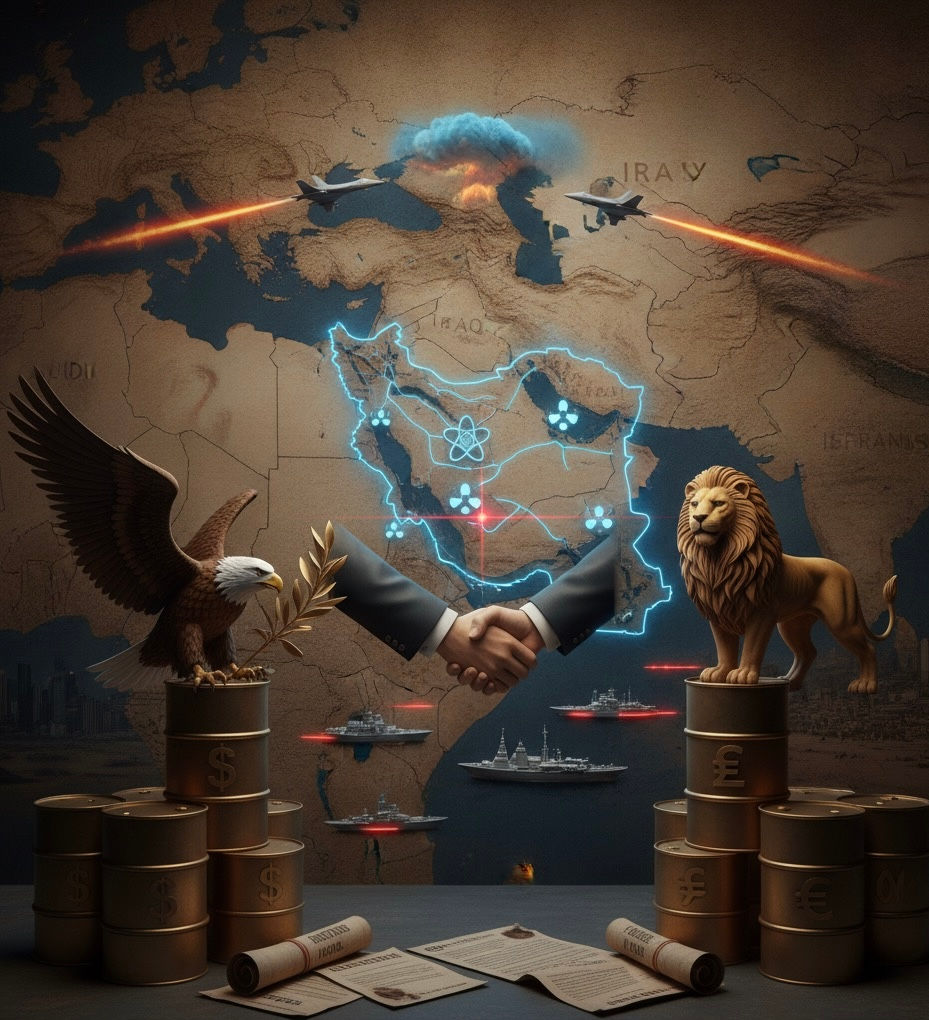
The Hormuz Stranglehold: Intelligence Gaps and Asymmetric Persistence in the Dual‑Blockade Era

By Mukhlis Mukhlis
The declaration that U.S. military action against Iran “terminated” on May 1, 2026,
is political craftsmanship—but it is also a strategic contradiction. The Executive Branch may tell Congress the War Powers clock has stopped, yet the situation on the water and ashore in the Arab Gulf is far more complicated. The conflict has not ended; it has shifted. What follows is a transition from open kinetic warfare to a period of sustained geo‑strategic constriction. This Dual‑Blockade era will reshape Middle Eastern security for years to come.
From an intelligence and military perspective, Tehran’s conventional capabilities have been severely degraded. The removal of senior leadership and the dismantling of roughly 85 percent of Iran’s missile‑manufacturing infrastructure have ended its role as a centralized regional hegemon. But the collapse of IRGC command‑and‑control has produced a different danger: a dispersed, asymmetric threat environment that no single carrier strike group can eliminate.

The Strategic Transition
The administration’s declaration signals a deliberate strategic pivot designed to give the Executive Branch operational flexibility in a post‑kinetic environment. Freed from a rigid legislative timeline, U.S. forces can pursue stabilization measures and respond to emergent threats with greater agility.
Central to this posture is the continued designation of the Strait of Hormuz as a controlled maritime zone. The naval presence is not merely symbolic; it is the operational bridge between battlefield gains and a durable geopolitical outcome. Maritime oversight of energy exports functions as an economic lever to deter disruption while a longer‑term diplomatic framework is negotiated. This is strategic patience: preserving initiative while converting military advantage into a stable regional architecture.
Intelligence Assessment of Proxy Persistence
The most consequential blind spot in current analysis is the resilience of the Axis of Resistance. Tehran’s central nervous system may be shattered, but its peripheral networks in Iraq, Yemen, and Lebanon remain active and adaptive. Activity‑based intelligence (ABI) indicates that pre‑positioned stockpiles of Tier‑1 drones and short‑range ballistic systems persist in the hands of decentralized cells.
The attack on Camp Buehring in Kuwait is a stark reminder that “terminated” hostilities do not equal safety for U.S. personnel or regional interests. The threat profile has shifted from coordinated state‑level campaigns to swarm‑and‑bleed tactics executed by autonomous units. These actors operate independently of diplomatic tracks; if Pakistan‑brokered talks or other negotiations fail to account for them, any agreement risks being hollow.
It is critical to establish a clear baseline for the current operational landscape:
• Houthi Strategic Posture: Despite aggressive rhetoric, Ansar Allah (Houthi) forces in Yemen have not yet transitioned to a state of substantive kinetic engagement. Their involvement remains below the threshold of a primary combatant in the current confrontation.
• Iraqi Proxy Capabilities: Iranian-aligned militias in Iraq—operating as direct affiliates of the IRGC-QF and maintain high operational tempo. These groups possess a robust arsenal of UAS (drones) and ballistic/cruise missiles, developed over the years through integrated engineering pipelines with IRGC-QF technical units. Operating under the banner of the Popular Mobilization Forces (PMF), these factions exploit their official status as a sovereign shield to mask their roles as proxies for the Iranian Revolutionary Guard (IRGC). This legal veneer grants them a level of political and security immunity that often eclipses that of the regular Iraqi Army. Paradoxically, the PMF provides these groups the cover to act independently, yet conveniently disavows them whenever their operations target international or regional interests.
• Operational Freedom: The ability of these proxies to maneuver without significant interdiction indicates a persistent and unmitigated threat. As long as these groups retain "freedom of movement," the regional security environment remains volatile and the threat unchecked.
The Economic Architecture of Reconstruction
Damage estimates between $300 billion and $1 trillion underscore the scale of the challenge. That destruction is both a strategic risk and a long‑term opportunity. A collapsed Iran invites radicalization and creates openings for external competitors—Russia and China among them—to expand influence in the vacuum.
The Dual‑Blockade is coercive but blunt. It pressures Tehran’s remnants to negotiate while simultaneously depriving the population needed to rebuild a moderate, post‑theocratic state. Without a deliberate pivot from containment to strategic reconstruction and civil stabilization, the United States risks winning the military campaign but losing the political peace. The vacuum is already contested by warlords and security‑service remnants, not diplomats.
The Strategic Path Forward
The United States must move beyond a binary conception of war or peace. The current environment is one of enduring competition that requires a more nuanced toolkit than naval blockades and declarative statements. The following policy priorities should guide the next phase:
Transition to a Multilateral Maritime Framework
Convert the unilateral blockade into a coalition maritime security architecture. Multinational enforcement will lend legitimacy, distribute political and logistical burdens, and normalize traffic through the Strait of Hormuz.
Independent Proxy Neutralization
Treat proxy networks as autonomous threats rather than mere extensions of a weakened Tehran. This demands localized, intelligence‑driven operations coordinated with regional partners to dismantle hostile cells on the ground.
Leverage the Grand Bargain
With the bulk of Iran’s missile‑manufacturing capacity degraded, the United States holds unprecedented leverage. Any easing of the naval and economic quarantine should be conditioned on verifiable dismantlement of nuclear capabilities and an end to extra‑territorial military financing.
Conclusion
The silence of heavy bombers in May 2026 should not be mistaken for peace. The Dual‑Blockade is a holding pattern, not a resolution. Iran’s transformation from revolutionary state to a neutralized or cooperative regional actor will not be achieved through declarations to Congress; it will require painstaking strategic work by planners and policymakers who understand that the most dangerous phase of any war is the one immediately after the last major strike.
The administration has degraded the enemy’s capacity to wage conventional war; it must now secure the conditions for political surrender and reconstruction. Until the Strait of Hormuz is fully normalized and proxy networks are dismantled, the conflict remains a dormant volcano. In geopolitics, a collapsing adversary can be more dangerous than a powerful one.