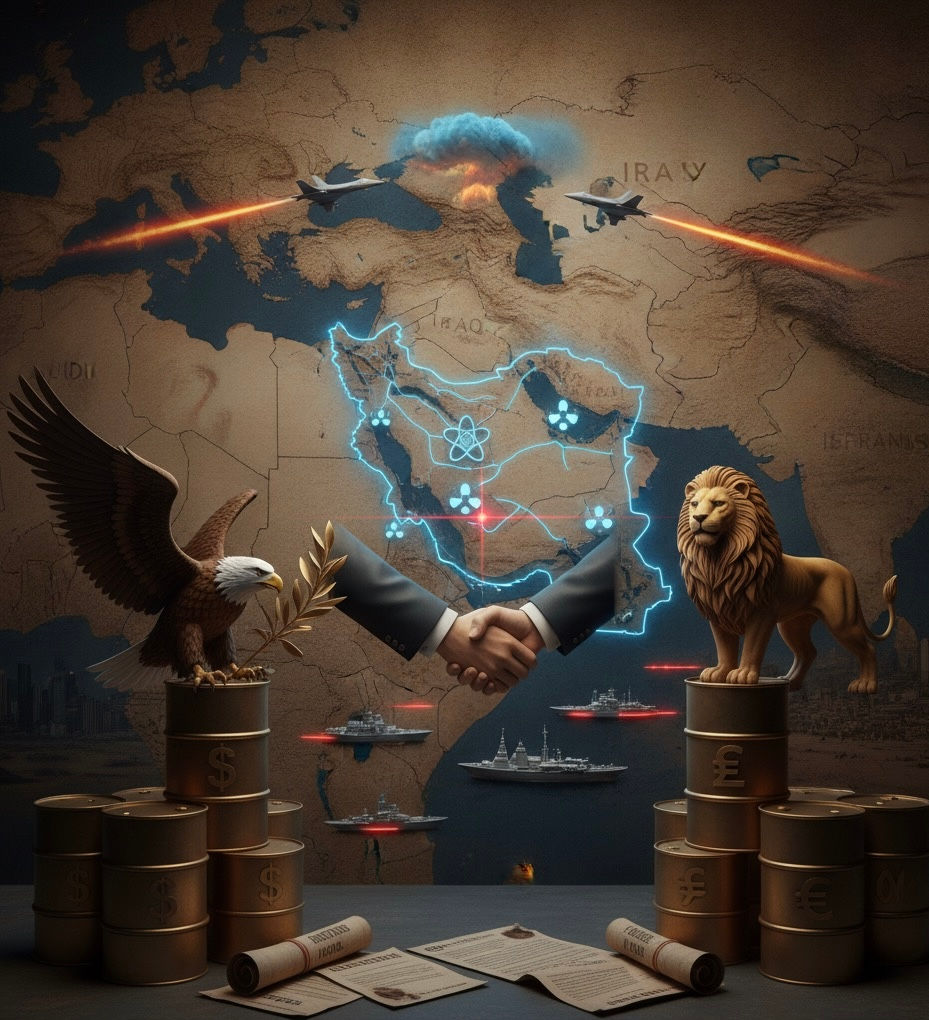
Operation Epic Fury and the Doctrine of Protraction: A Comprehensive Assessment of Iranian Strategic Depth and Logistical Choke Points


The first quarter of 2026 has witnessed a fundamental phase shift in the Middle Eastern security architecture. Following the intensive kinetic degradation of Tehran’s conventional ballistic and nuclear infrastructure during Operation Epic Fury, the Iranian regime has retreated into a doctrine of "Strategic Sustainment and Attrition." This is no longer a war of state-on-state parity, but a desperate, decentralized struggle for regime survival. By weaponizing the temporal dimension and leveraging its vast, rugged geography, Tehran seeks to transform its military insolvency into a political quagmire, gambling that the coalition's appetite for sustained regional engagement will erode before the IRGC’s "Deep State" networks are fully uprooted.
Central to this survival strategy is the exploitation of the "Iraqi Lung." With the collapse of the Assad regime in Syria and the systematic decapitation of Hezbollah’s core in Lebanon, Iraq has transitioned from a proxy theater to Iran’s primary strategic depth. The Iranian "strategic mind" is currently betting that its structural infiltration of the Iraqi financial and security sectors will provide the fiscal and logistical oxygen necessary to sustain a multi-year asymmetric campaign. Consequently, the resolution of this conflict now hinges less on the bombardment of the Iranian heartland and more on a surgical intelligence-led campaign to decouple the Iraqi state from the IRGC’s transnational apparatus.
I. Strategic Ambiguity and the "Protraction" Paradox
Current theater intelligence as of March 2026 presents a distinct paradox: while quantitative data confirms the near-total degradation of Iran’s conventional military infrastructure, the regime’s leadership remains committed to a doctrine of "Strategic Protraction" (Tactical Endurance). This strategy is not based on material parity but on a calculated gamble that their "strategic mind" can outlast the coalition's political willpower. We must avoid the trap of dismissing "Mullah bluster" as merely hollow; rather, it is a deliberate psychological framework designed to convert military losses into a long-term political stalemate.
II. Crisis Management: The Historical "Machiavellian" Pattern
Since 1979, Tehran has consistently utilized a three-tiered crisis management model to navigate existential threats:
Direct Confrontation Avoidance: Evading high-kinetic parity with superior powers.
Asymmetric Leverage: Total reliance on non-linear warfare, specifically drones, cyber operations, and proxies.
Weaponized Time: Using time as an abrasive force to transform an adversary’s tactical success into a political liability.
Tehran views the current conflict not as a battle for territory, but as a test of endurance. Their objective is to force a settlement by making the "cost of victory" unsustainable for the coalition.
III. Geography as an Operational Shield
Iran’s physical landscape remains a formidable obstacle to a rapid, decisive victory:
Territorial Vastness (1.6M km^2): Total paralysis via airpower is statistically improbable. We must draw lessons from the Tora Bora and Afghan campaigns; the Zagros and Alborz ranges provide a natural "hardened depth" that allows for the persistent dispersal of high-value IRGC assets.
Geopolitical Pivot: Its position at the crossroads of Central Asia and the Caucasus allows for continuous geopolitical maneuvering, even under the "Maximum Pressure 2.0" sanctions of 2025–2026.
IV. Domestic Fatigue and Elite Fractures
The Iranian economy has moved from "resistance" to Structural Exhaustion. 2026 OSINT indicates hyper-inflation and a total collapse of the Rial, creating a widening chasm between the populace and the "Bazaari" elite. Furthermore, the regime is no longer a monolith; intelligence suggests deepening friction between "Escalation Realists" (loyal to the new Supreme Leader Mojtaba Khamenei) and "Containment Pragmatists" within the regular army (Artesh) who fear total state collapse.
V. The Hormuz Dilemma and Global Deterrence
The Strait of Hormuz remains Tehran’s primary "dual-edged" lever. While the threat of mining or high-speed swarm attacks (utilizing the IRGC Navy's decentralized fleet) can paralyze global energy markets, Tehran is acutely aware that closing the Strait would invite a "Total War" scenario that would end the regime’s existence. It remains a weapon of blackmail rather than execution.
VI. The Iraqi Theater: The "Lung" of the Revolutionary State
The fall of the Syrian regime in 2024 and the neutralization of Hezbollah’s core in Lebanon have left Iraq as the sole remaining "strategic lung" for the IRGC.
The Deep State IRGC: Factions within the Popular Mobilization Forces (PMF) have successfully hijacked the Iraqi sovereign apparatus. These groups (AAH, KH) operate as a "state within a state," utilizing the 2024–2025 PMF Law to secure independent budgets while answering directly to Tehran.
Retaliatory Slippage: A primary risk is the "Iraqi Slide," where proxies target neighboring Arab states, U.S. and coalition diplomatic missions, facilities, and installations to relieve pressure on the Iranian heartland.
VII. Operational Roadmap: Neutralizing Choke Points
To collapse the Iranian capacity for protraction, we must target the following "Logistical Choke Points" in Iraq:
Financial Sequestration: Active dismantling of the "Shadow Banking" networks (front companies like the Muhandis General Company) that launder USD into the IRGC’s regional war chest.
The "Yellow Zone" Interdiction: Treating proxy strongholds in Jurf al-Sakhar and the Western Desert as legitimate military nodes. We must sever the land-bridge that connects the Iranian heartland to the Mediterranean.
The Narco-Terror Nexus: Intelligence from February 2026 confirms that Hezbollah’s Latin American "Khatiba" cells are increasingly integrated with Mexican and Colombian cartels to fund operations. We must treat the Tri-Border Area (TBA) in South America as an extension of the Iraqi front.
Institutional De-Legitimization: Stripping the PMF of its legal and political cover, treating its constituent militias as transnational terrorist organizations (akin to AQ, AQI, and ISIS) rather than state-sanctioned actors.
VIII. Conclusion: The Path to Permanent Eclipse
The future of this confrontation will not be settled by broad-spectrum bombing, but by "Intelligence-led Surgery." Iran’s Machiavellian gamble ends when it is isolated geographically, bankrupted financially, and stripped of its asymmetric tools in Iraq. By severing the Iraqi "Lung," we do not just win a theater, we ensure the permanent and eternal collapse of the 1979 Revolutionary project.