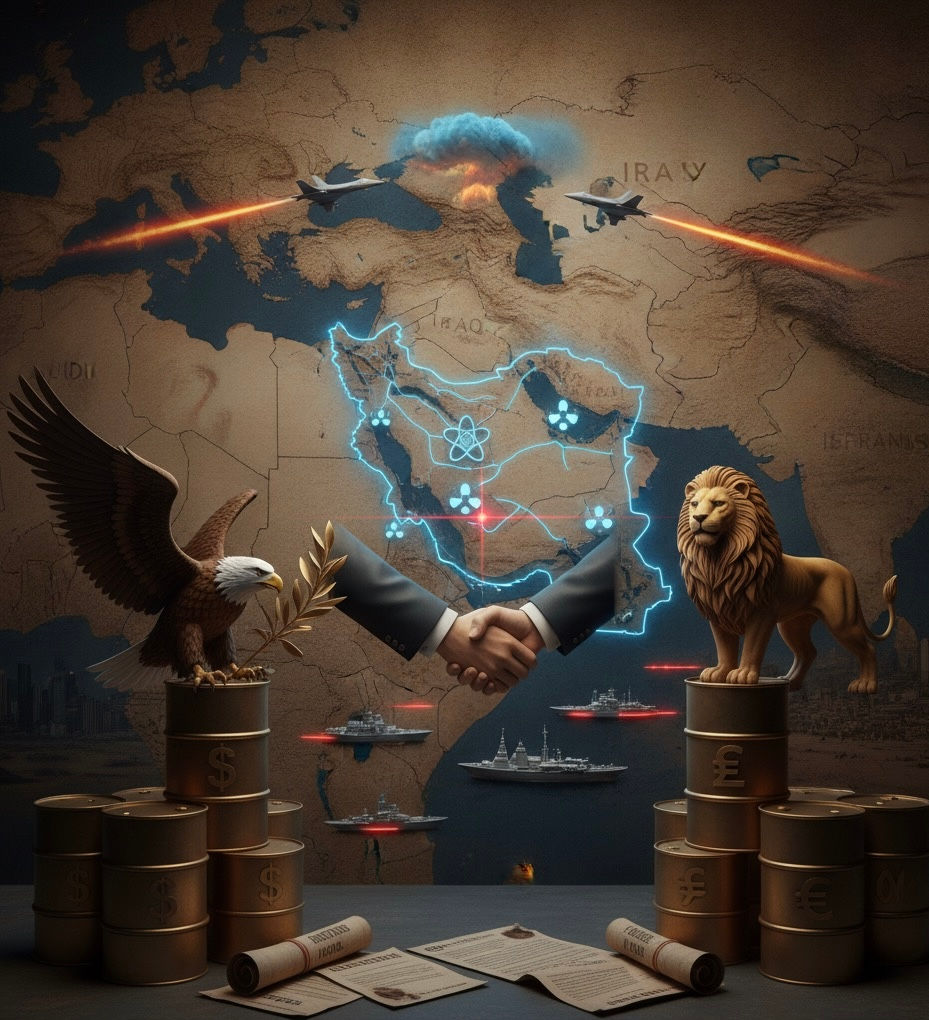
The Indus-Persian Nexus: Pakistan as Iran’s "Nuclear Flank"

The spectacular failure of the "High-Stakes Accord" in Islamabad on April 11–12,
2026, between U.S. Vice President J.D. Vance and Iranian Speaker Mohammad Baqer Qalibaf, marks a watershed moment in 21st-century geopolitics. While the Beltway remains focused on the collapse of the formal agenda, the true significance of the summit lies in its exposure of a long-denied reality: Pakistan’s role as the indispensable "Nuclear Flank" of the Iranian Revolutionary state.

For decades, U.S. foreign policy has treated Pakistan as a transactional, if difficult,
Major Non-NATO Ally (MNNA). This assessment is no longer tenable. Historical precedent, compounded by Pakistan’s role during the recent U.S.-Iran stalemate, reveals that Islamabad is not an impartial mediator. Instead, it functions as the "Strategic Lung" for Tehran, leveraging Western and Gulf Cooperation Council (GCC) capital to construct a civilizational and military shield for Iran, a "Perso-Indus axis", designed to decouple the region from U.S. hegemony once and for all.
I. CIVILIZATIONAL GENETICS: THE PERSIANATE DEEP STATE
The primary failure of Western intelligence has been the assumption that Pakistan’s Sunni-majority demographic dictates its strategic orientation. An in-depth analysis reveals a "Persianate genetic code" within Pakistan’s elite that transcends sectarian lines. However, what serves as an established axiom for seasoned practitioners is frequently dismissed or overlooked by the foreign policy establishment, resulting in a profound disconnect between intelligence assessments and geopolitical facts.
The Elite Umbilical Cord: Persian was the language of the Mughal courts and the administrative precursor to the modern Pakistani state, leaving an indelible imprint on the military aristocracy. The Pakistani "Establishment" is fundamentally integrated with families of Persian descent, notably the “Bhutto” and “Mirza” dynasties. Furthermore, a fact that is often overlooked is that—despite the fact that more than 90 percent of Pakistan's Muslims are Sunni—it is the Shia minority that holds the reins of power in Pakistan.
The "Safe Rear" Doctrine: Iran was the first state to recognize Pakistan in 1947 and provided critical support during the 1965 and 1971 wars with India. This solidified a foundational doctrine: Iran is Pakistan’s indispensable strategic flank. While Islamabad accepts billions from the GCC, its primary security loyalty remains anchored to this non-Arab Muslim axis.
II. THE BAGHDAD PACT: INCUBATION OF THE PERSO-INDUS AXIS
To truly understand the modern Indo-Persian axis, we must look back at the “1955 Baghdad Pact” (later renamed “CENTO”). While Washington viewed this alliance as a simple Cold War tool to keep the Soviets away from "warm water" ports, for Pakistan, it was a masterclass in regional survival and identity-building.
The "Northern Tier" vs. The Arab Heartland
The Baghdad Pact was designed by the West to create a "Northern Tier" of pro-Western states (Turkey, Iraq, Iran, and Pakistan). However, Pakistan’s entry was driven by a specific, non-Western logic, effectively institutionalizing a non-Arab Muslim alliance:
The Anti-Nasserism Shift: During the 1950s, the Arab world was swept up in the pan-Arab nationalism of Egypt’s Gamal Abdel Nasser. Pakistan, founded on religious rather than ethnic identity, found Nasser’s secular Arabism threatening. By aligning with the Iranian Monarchy and Turkey, Pakistan built a strategic wall between itself and the unpredictable, often pro-Soviet, Arab street.
A Mutual Defense Shell: While the Pact’s formal enemy was the USSR, Pakistan and Iran used the alliance to build a private "intelligence and logistics club." For Islamabad, the Pact was about ensuring that if war broke out with India, Iran would provide the fuel, aircraft sanctuary, and diplomatic cover it needed to survive.
Institutionalizing the Nexus
The Pact provided the first formal legal framework for the Pakistani military to train and plan alongside the Iranian state, creating a shared security language:
Bypassing the West: Even with the UK as a member and the U.S. as an observer, Pakistan and Iran used the Pact’s sub-committees to coordinate on regional concerns—like Baloch separatism—that the West ignored. They learned to coordinate internal security apparatuses, a skill set that evolved into the modern “ISI-IRGC cooperation”.
The Blueprint for Autonomy: When CENTO failed to support Pakistan during its wars with India, the lesson for Islamabad was clear: Western alliances are fickle, but regional neighbors are permanent. This "betrayal" accelerated the shift from Western outpost to "Guardian of the Iranian Flank," as Pakistan realized a strong Iran was its only guarantee of a secure western border.
The “A.Q. Khan” dossier, long treated as a "rogue" operation, must be reclassified as state-sanctioned "Nuclear Proliferation as a Diplomatic Shield."
Pakistan successfully marketed its nuclear program to Riyadh and Tripoli as the "Sunni Response" to Israel to secure funding. In reality, it was a joint venture with Tehran. Between 1987 and 1995, the ISI’s "S-Wing" facilitated the transfer of P-1 and P-2 centrifuge designs to Iran. This "Nuclear Entanglement" utilized Arab capital to build a nuclear umbrella that protects the Shia Revolutionary state. Consequently, any strike on Iranian nuclear facilities is viewed by Islamabad as a threat to its own sovereign deterrent, creating an operational "mutual defense" reality.
IV. CASE STUDY: "ASSISTED OBSTRUCTIONISM" AT THE 2026 SUMMIT
The April 2026 stalemate was engineered through Pakistani tactical support for the Iranian delegation:
SIGINT Masking: The ISI provided the Iranians with hardened, fiber-optic communication lines and localized jamming, bypassing Western surveillance.
The "Red Line" Leak: Pakistani intermediaries reportedly briefed Speaker Qalibaf on the specific "engagement triggers" of the U.S. 5th Fleet, allowing Iran to maintain an uncompromising stance.
Sanctions Bypass: Simultaneously, Pakistan finalized protocols for the
Iran-Pakistan (IP) Gas Pipeline, ensuring Tehran an economic lifeline despite "Tier-1" sanction threats.
V. THE NEW IRON CURTAIN: EURASIATIC INTEGRATION
The consolidation of this Eurasiatic alignment is a multi-domain integration designed to dismantle U.S. leverage. On the energy front, the “IP Gas Pipeline” neutralizes U.S. sanctions. In defense, the transfer of JF-17 avionics and airframe tech gives the Iranian military a shortcut to modernization.
Furthermore, the expansion of CPEC-linked monitoring infrastructure allows for a seamless intelligence flow that stretches China’s reach to the Persian Gulf. Perhaps most unsettling is the "scientific cooperation" behind closed doors; Islamabad is essentially acting as a technical backup for Iran’s nuclear "breakout" capability, ensuring Tehran retains the specialized knowledge to cross the threshold at its choosing.
RECOMMENDATIONS FOR U.S. POLICY
1. Terminate the "Neutral Arbiter" Fallacy: any future negotiations (if any) must move to neutral ground (e.g., Geneva, Vienna, or Kuala Lumpur ) where the host's intelligence apparatus is not actively working for the opposition.
2. Reassess MNNA Status: Revoke Major Non-NATO Ally status to signal that strategic duplicity has costs.
3. Secondary Sanctions on the ISI: Target the "S-Wing" and directorates facilitating IRGC financial and technical bypass operations.
4. The Nuclear Variable: Assume Pakistan’s arsenal serves as a “Strategic Reserve” for Iran; military planners must factor in Pakistani "Nuclear Signaling" during any Iranian contingency.
INTELLIGENCE CONCLUSION
The Baghdad Pact was the “incubation chamber" for a nexus that allowed Pakistan to absorb Western military technology and repurpose it to protect Tehran. The "Islamic Bomb" was the Trojan Horse that allowed Pakistan to survive on Western and Arab credit while empowering a Persian hegemon. Pakistan is no longer a partner in regional stability; it is the “Guardian of the Iranian Flank”. The Indo-Persian nexus is the new Iron Curtain, and the United States must treat it as such.